Plug-in the variable below...
Math
Sunday, October 9, 2011
Describe and how to solve TPS and Difference of 2 Squares
Different of 2 squares:

or the other way around.
Examples:
or the other way around.
Examples:
- (49x² - 64) = (7x + 8)(7x - 8)
- (4x + 6)(4x - 6) = 16x² - 36
Squaring Numbers that End in 5
65
We add 1 to the first digit of the number which is 6
So we get 7
We multiply the first digit of the number(6) and the number we just got(7)
equals 42
Then we add 25 to the end of 42.
so you get: 4225
Example:
We add 1 to the first digit of the number which is 6
So we get 7
We multiply the first digit of the number(6) and the number we just got(7)
equals 42
Then we add 25 to the end of 42.
so you get: 4225
Example:
Changing Decimals to Fractions
Changing Decimals to Fractions:
| Step 1: Write down the decimal divided by 1, like this: decimal/1 |
| Step 2: Multiply both top and bottom by 10 for every number after the decimal point. (For example, if there are two numbers after the decimal point, then use 100, if there are three then use 1000, etc.) |
| Step 3: Simplify (or reduce) the fraction |
Friday, September 16, 2011
Rules of Exponents
1) A variable with the exponent 1 is same variable.
2) When the exponent is zero the variable(Or whatever the variable is) always equals 1.
3) When the exponent is negative, put 1 over the variable and make the exponent positive.
4) When multiplying the variables with exponents, add the exponents and multiply the variables.
5) When dividing the variables with exponents, subtract the exponents and divide the variables.
6) When the variable x cubed is being squared, you multiply the 3 and 2.(from the example)
7) When the the variables xy is cubed, then each of the variable are cubed.(from the example)
8) When x divided by y is being cubed, then you cube both x and y.(from the example)
9) When the exponent is negative, put 1 over the variable and make the exponent positive.
2) When the exponent is zero the variable(Or whatever the variable is) always equals 1.
3) When the exponent is negative, put 1 over the variable and make the exponent positive.
4) When multiplying the variables with exponents, add the exponents and multiply the variables.
5) When dividing the variables with exponents, subtract the exponents and divide the variables.
6) When the variable x cubed is being squared, you multiply the 3 and 2.(from the example)
7) When the the variables xy is cubed, then each of the variable are cubed.(from the example)
8) When x divided by y is being cubed, then you cube both x and y.(from the example)
9) When the exponent is negative, put 1 over the variable and make the exponent positive.
Matricies
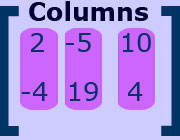
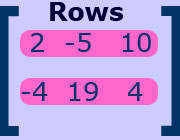
Dimensions of a Matrix:
# of Rows x # of Columns
There are 2 Rows There are 3 Columns
Example:
# of Rows: 3
# of Columns: 2
So it is a 3x2 matrix
Subscribe to:
Comments (Atom)